finished for now · jan 2026 - apr 2026
Parking Shark
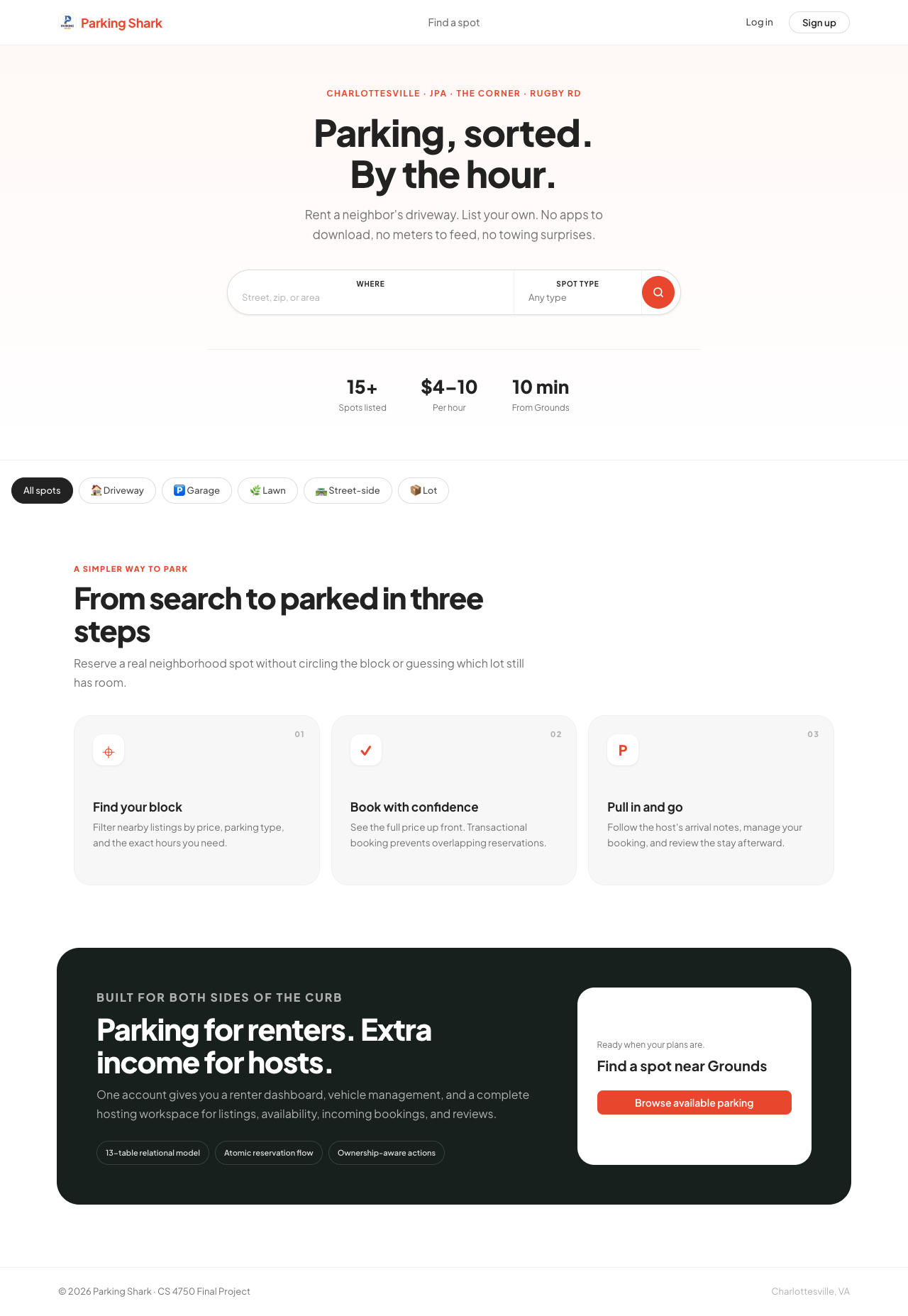
Built with a four-person UVA team, Parking Shark lets renters find and reserve neighborhood parking while hosts manage listings, availability, bookings, and reviews.
Parking around Grounds is a weird problem. A driveway can sit empty a block away while someone else circles for a spot. We built Parking Shark to connect those two people without making either side manage the arrangement through a group chat.
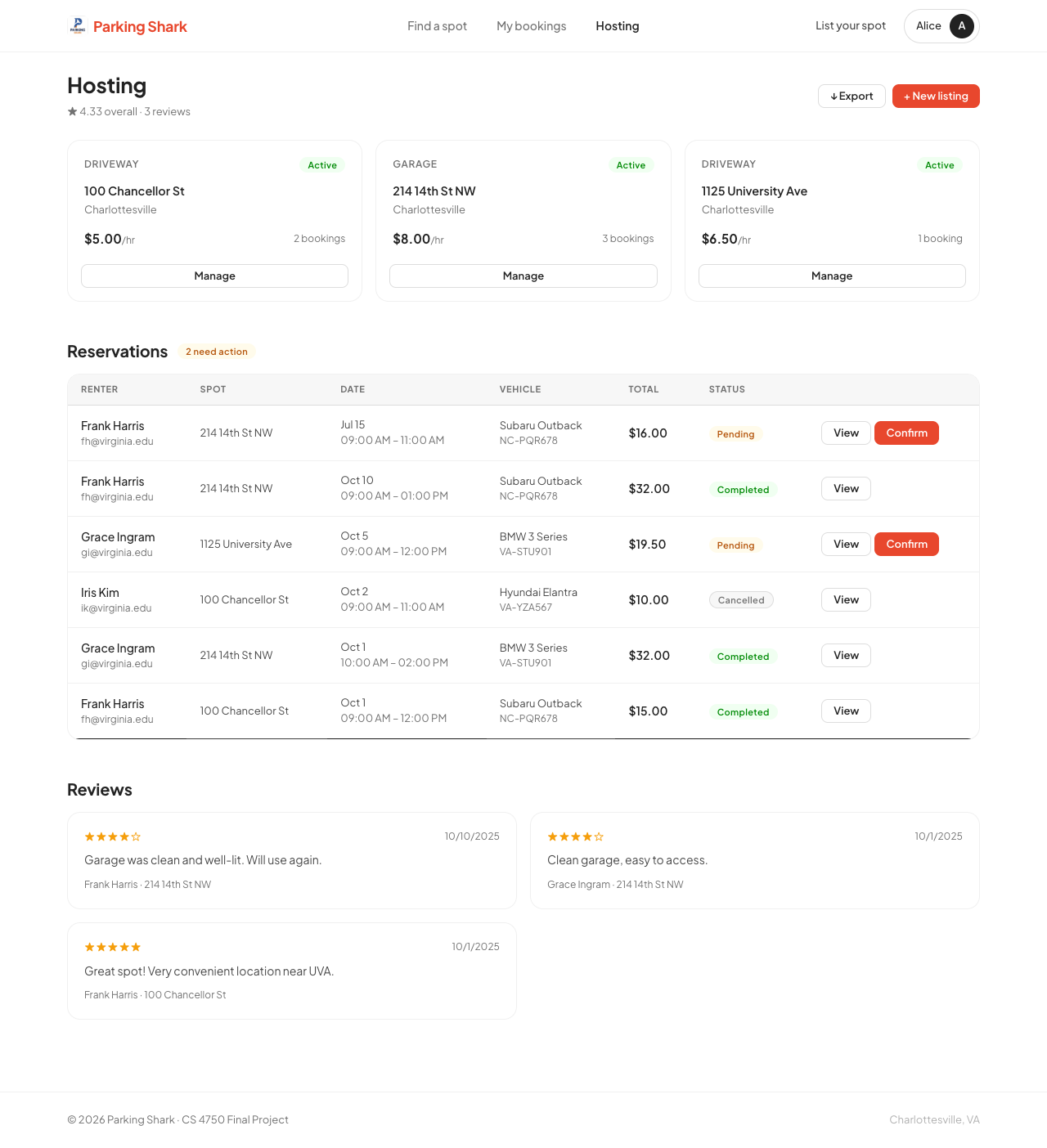
This was a four-person UVA database project, and we built it together in the same room. The app covers both sides of the marketplace: renters can search, filter, book, pay, and review, while hosts can list spaces, manage availability, confirm reservations, and keep track of what is happening across their spots.
The hosted demo makes that full loop easy to review. You can request a sample spot as a renter, switch to the host view to approve and complete the stay, then return as the renter to record payment and leave a review. Each visitor gets isolated signed demo state, so the workflow is real without exposing student accounts or collecting payment details.
the part underneath the screens
The Express app sits on a 13-table MySQL model covering people, vehicles, parking spots, schedules, reservations, payments, extensions, and reviews. The important part was not just storing all of it. The rules had to hold when real actions crossed table boundaries.
- booking and extension checks run inside transactions so two overlapping requests cannot both win
- reservation actions are tied to the right renter or host
- payments only work for an eligible renter and reservation state
- status changes follow one valid path instead of accepting arbitrary updates
- a database-aware health check catches the difference between a running web server and a working app
The hosted version is a way to try the project, not a replacement for the original database system. It runs the marketplace flow with safe sample data because the course database is not public. The original app still uses the Express routes, MySQL schema, stored procedure, overlap trigger, and local database setup.
giving the project a proper second pass
The first course version proved the idea, but it still had the kind of gaps that show up when a team is racing toward a deadline. I came back to it and fixed the parts that felt rushed: stricter validation, checks that keep renters and hosts in the right places, request protection, login rate limits, security headers, a clean database setup, automated tests, and CI.
That second pass made the project more useful to show because it is no longer just a set of screens. The renter and host paths now agree with the rules in the database, and the repository explains how to reproduce the whole thing locally.